
LISTEN NOW!
There was a strange thing about being a kid in the 1980s. Adults were always warning us about what might happen if we stayed out too late, talked to strangers, went somewhere we weren’t supposed to go, or generally did any of the things we spent most of our childhood doing. Then we went to the movies and watched teenagers make those exact mistakes, only instead of getting grounded, they got murdered.
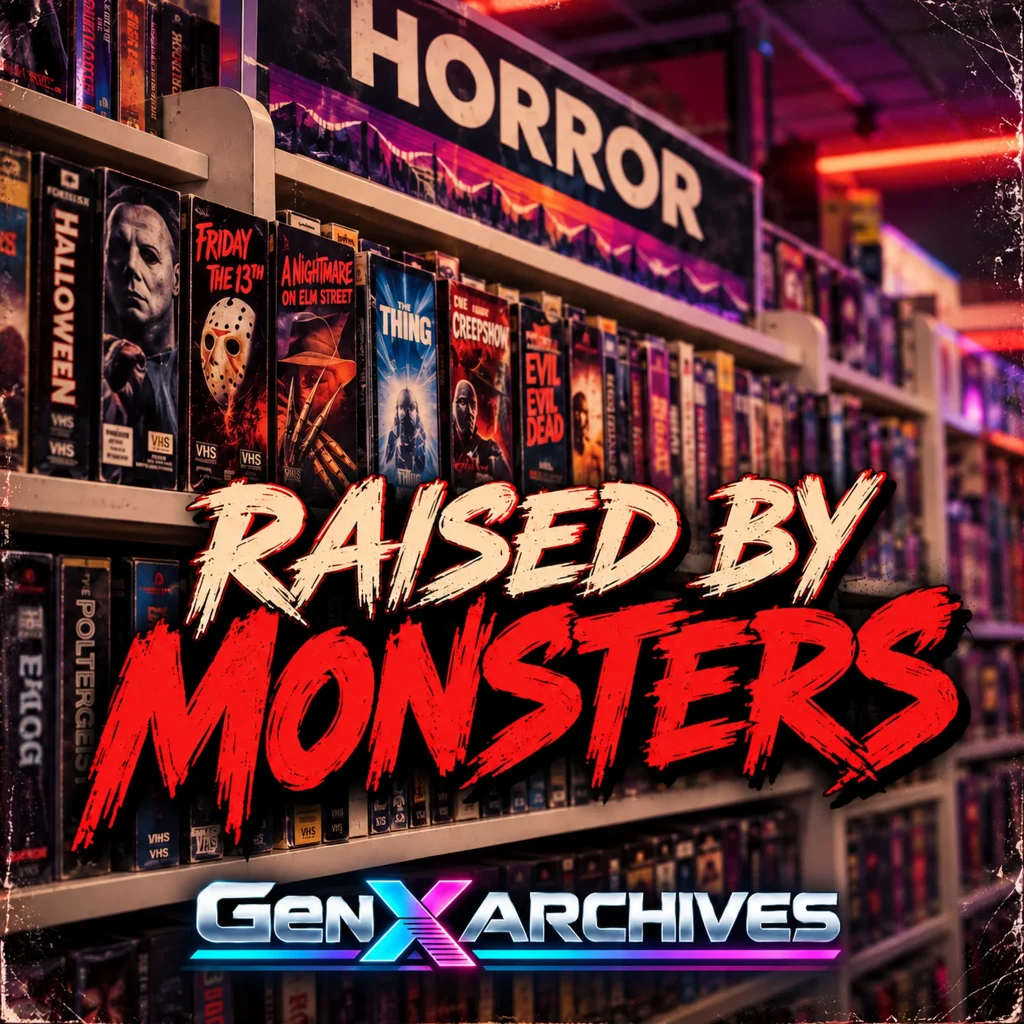
That is the starting point for the latest episode of the Gen X Archives Podcast, Raised by Monsters: How Gen X Grew Up with Horror.
If you grew up in the 1970s and 1980s, horror seemed to be everywhere. Michael Myers was stalking suburban neighborhoods, Jason Voorhees was waiting at summer camp, and Freddy Krueger eventually figured out that he didn’t even need to wait until you were awake. Somehow, these monsters became celebrities. They were on posters, magazine covers, Halloween masks, T-shirts and, most importantly for a lot of us, video-store shelves.
When Horror Came Home
Horror movies certainly didn’t begin with Generation X. The monsters had been around for decades, and Universal had already given movie audiences Dracula, Frankenstein’s monster, the Wolf Man and the Creature from the Black Lagoon. The 1950s added atomic monsters, alien invasions and pod people, but by the 1960s and 1970s the danger was beginning to move much closer to everyday life.
Psycho shifted the horror out of the Gothic castle and into an ordinary motel. The Exorcist put it inside a family home. The Texas Chain Saw Massacre took it onto a lonely road, while Black Christmas brought it into a sorority house. By the time John Carpenter made Halloween in 1978, the monster had arrived in the neighborhood.
That movie helped bring together a formula that would dominate much of the next decade: teenagers, an ordinary setting, a masked killer, a final survivor and the uneasy suggestion that the nightmare might not really be over. Hollywood also noticed something else about Halloween. It was inexpensive to make and wildly profitable, which meant every producer in town suddenly had a reason to start looking for the next masked killer.
The floodgates opened.
Welcome to the Horror Aisle
Then the VCR changed everything.
Before home video, you watched whatever the theater was showing or whatever happened to be on television. VHS brought the movies home, and video stores put hundreds of them on shelves where a kid could wander through the horror section staring at artwork he was probably too young to see.
Those boxes were half the experience. They were covered with skulls, masks, knives, blood-red lettering, hands crawling out of graves and taglines that read like dares. Sometimes the cover was considerably scarier than the movie inside, but by then it had already done its job.
Maybe you couldn’t rent the movie yourself, although depending on the video store that rule could be surprisingly flexible. Maybe your older brother or sister rented it. Maybe somebody brought it to a sleepover, or you watched it at a friend’s house because their parents either didn’t know or didn’t care.
That was how a lot of us encountered horror. It usually wasn’t some grand act of rebellion. Somebody had the tape, somebody’s parents weren’t home, and eventually someone asked, “You guys want to watch this?”
Of course we did.
Subscribe to the Newsletter!
Michael, Jason and Freddy
By the middle of the decade, three monsters had become nearly impossible to avoid: Michael Myers, Jason Voorhees and Freddy Krueger. You barely needed the last names anymore.
What is interesting looking back is how differently each one worked. Michael made the ordinary neighborhood feel dangerous because there was no safe distance between you and the threat. Jason turned summer camp, a place associated with freedom and being away from parents, into a trap. Freddy pushed the idea even further because you could leave Haddonfield and you could avoid Camp Crystal Lake, but eventually everybody had to go to sleep.
There was another idea running through many of these movies too: the adults were rarely much help. Sometimes they didn’t believe the kids, sometimes they weren’t around, and sometimes, especially in A Nightmare on Elm Street, they had helped create the problem in the first place.
For a generation that became known for coming home to empty houses, letting itself in and figuring out the afternoon until a parent showed up, maybe that idea felt more familiar than we realized at the time.
Horror Was Bigger Than the Slashers
The 1980s horror boom was much more than Michael, Jason and Freddy. Poltergeist managed to traumatize kids with a clown while somehow carrying a PG rating. John Carpenter’s The Thing disappointed at the box office but found a new audience later through cable and home video. Movies like The Evil Dead, An American Werewolf in London, The Fly, Fright Night, The Lost Boys, The Monster Squad and Child’s Play showed just how broad the decade’s horror could be.
This was also the golden age of practical effects. Artists such as Tom Savini, Rick Baker and Rob Bottin became celebrities within horror fandom, while magazines like Fangoria showed kids how the monsters were actually made. For some viewers, the thing that frightened them eventually became the thing they wanted to understand. How did they make that head explode? How did they build that creature? How did they pull off that transformation?
That curiosity helped turn horror into more than something you watched. It became a hobby, a subculture and, for some people, a path into filmmaking, makeup, effects or writing.
And Then the Adults Noticed
Of course, adults had questions. Critics attacked slasher movies, parents protested films like Silent Night, Deadly Night, and Britain had its infamous “video nasties” panic.
Some of the concern was understandable. Kids really can see things they aren’t ready for, and certain images or fears can stick around for years. A nine-year-old and a nineteen-year-old are not watching The Exorcist the same way.
What never really held up was the much bigger claim that watching Freddy Krueger or renting a slasher movie was somehow going to turn an entire generation violent. The reality was more complicated. Horror affected people differently, but for a lot of Gen X kids it became part of the culture we shared.
Those movies became sleepovers, Halloween costumes, magazine collections, inside jokes, favorite video-store discoveries and arguments over which monster would win in a fight. They scared the hell out of us, and we kept coming back.
Maybe we weren’t actually raised by monsters, but they were definitely hanging around while we grew up.
And I’m pretty glad they were.
Listen to Raised by Monsters: How Gen X Grew Up with Horror on the Gen X Archives Podcast.
What horror movie got you? Maybe it was the one you watched too young, the one somebody brought to a sleepover, or just the VHS box you couldn’t stop staring at in the video store.
Send your story to podcast@genxarchives.com or leave a message at 720-722-1066.
Movies Mentioned in This Episode
Nosferatu (1922), Dracula (1931), Frankenstein (1931), The Mummy (1932), The Wolf Man (1941), Creature from the Black Lagoon (1954), Godzilla (1954), Them! (1954), Invasion of the Body Snatchers (1956), Psycho (1960), Night of the Living Dead (1968), The Last House on the Left (1972), The Exorcist (1973), The Texas Chain Saw Massacre (1974), Black Christmas (1974), Jaws (1975), Carrie (1976), The Omen (1976), The Hills Have Eyes (1977), Halloween (1978), Friday the 13th (1980), Prom Night (1980), Terror Train (1980), The Evil Dead (1981), An American Werewolf in London (1981), My Bloody Valentine (1981), Happy Birthday to Me (1981), Graduation Day (1981), Friday the 13th Part 2 (1981), Poltergeist (1982), The Thing (1982), Friday the 13th Part III (1982), A Christmas Story (1983), Sleepaway Camp (1983), Ghostbusters (1984), Gremlins (1984), Indiana Jones and the Temple of Doom (1984), Friday the 13th: The Final Chapter (1984), A Nightmare on Elm Street (1984), Silent Night, Deadly Night (1984), Friday the 13th: A New Beginning (1985), Re-Animator (1985), The Return of the Living Dead (1985), Fright Night (1985), Friday the 13th Part VI: Jason Lives (1986), The Fly (1986), Witchboard (1986), A Nightmare on Elm Street 3: Dream Warriors (1987), The Lost Boys (1987), The Monster Squad (1987), Child’s Play (1988), and Scream (1996).
Also mentioned: Trilogy of Terror, Dark Shadows, Salem’s Lot, Freddy’s Nightmares, Michael Jackson’s Thriller, and Stranger Things
Sources & Further Reading
Clover, Carol J. Men, Women, and Chain Saws: Gender in the Modern Horror Film. Princeton, NJ: Princeton University Press, 1992.
Egan, Kate. Trash or Treasure? Censorship and the Changing Meanings of the Video Nasties. Manchester: Manchester University Press, 2007.
Greenberg, Joshua M. From Betamax to Blockbuster: Video Stores and the Invention of Movies on Video. Cambridge, MA: MIT Press, 2008.
Newman, Kim. “Vile VHS: Unspooling the History of the ‘Video Nasty’ Controversy.” Sight and Sound, May 29, 2021.
Nowell, Richard. Blood Money: A History of the First Teen Slasher Film Cycle. New York: Continuum, 2011.
Phillips, Kendall R. Projected Fears: Horror Films and American Culture. Westport, CT: Praeger, 2005.
Rockoff, Adam. Going to Pieces: The Rise and Fall of the Slasher Film, 1978–1986. Jefferson, NC: McFarland, 2002.
American Film Institute. “Halloween.” AFI Catalog of Feature Films. The AFI entry includes production history for the film, including Tommy Lee Wallace’s modification of the William Shatner/Captain Kirk mask used for Michael Myers.
Day, Patrick. “Injecting Life Into a Familiar Boogeyman.” Los Angeles Times, April 24, 2002. This Sean S. Cunningham interview is especially useful for the origin and early development of Friday the 13th, including Cunningham’s famous Variety ad before the film was fully developed.
🕹️To Greg, a friend since childhood. He always embodied the true spirit of Gen X. He may be gone, but the legend lives on! 🤘